HomeClerk is free to use. We may earn a fee when you request quotes or visit a partner via links on this site. This doesn’t affect our scores or rankings, see How We Rate. Advertising Disclosure
Last updated: October 2026
Best Stair Lifts of 2026
Keep using every floor of your home
Compare stair lift brands on price, fit and reliability for straight, curved and outdoor staircases, with free home quotes.
After comparing 4 providers on five weighted factors, Bruno is our top pick,
best for build quality and smooth ride. Stannah is the stronger
choice for complex and curved staircases.
A stair lift is often the difference between staying in a much-loved home and a difficult move. Prices depend mostly on your staircase: straight runs are economical, curved and custom rails cost more. Every reputable brand quotes after a free home assessment, so comparing two or three quotes is the single best way to pay a fair price. We compared the major brands on build quality, warranty, dealer network and value.
How we chose
Every stair lifts provider here gets the same treatment: the HomeClerk research
team scores it on five weighted factors, the weights are published, and no provider can pay to move
up. Commissions never touch the math.
What straight and curved lifts cost from these brands
Your staircase sets the price, and the gap between straight and curved is the biggest number on this page. Among the brands we compare, straight lifts installed start at roughly $2,500 from Acorn, around $2,800 from Harmar, about $3,000 from Bruno and near $3,500 from Stannah.
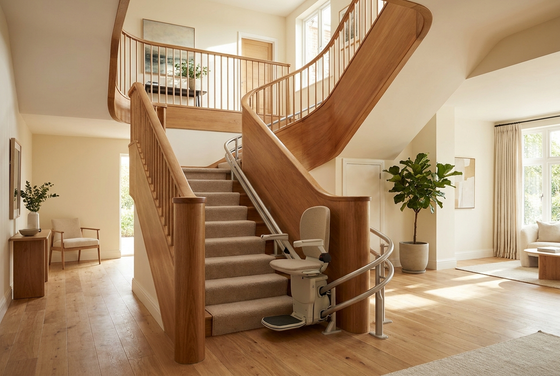
Curved staircases are a different product. The rail has to follow your exact stairs, and that rail is most of the cost: Stannah's curved lifts start around $9,000, and Bruno quotes curved installs custom after a home visit. Acorn takes a third path with a modular rail system that assembles to fit turns, which is faster and often cheaper than fully custom, though less tailored to awkward staircases.
Treat every starting price as the simple-case figure. Longer runs, landings, powered swivel seats and higher weight capacities all push a quote up, which is why the same staircase can draw noticeably different numbers from different installers. That is also why getting two or three quotes is the single best lever you have on price.
Buying new, reconditioned or renting
Before comparing brands, decide how long the lift needs to serve. The answer changes what you should buy.
For long-term use, new makes sense: full warranty, current hardware, and the installed prices above. For straight staircases on a budget, ask every dealer about reconditioned units; in our research, refurbished straight lifts can save 30 to 50 percent. Curved lifts rarely recondition well, because the rail was built for someone else's staircase.
For a recovery from surgery or another short-term need, renting usually beats buying. Most dealers that offer rentals charge a monthly fee plus installation and removal, and the arithmetic typically favors renting for needs under a year or so. Ask each installer to quote both ways, since not every brand rents in every area.
One honest caution on used lifts bought privately: the savings can evaporate if no local dealer will service the unit. Confirm service availability before money changes hands, not after.
When moving makes more sense than a lift
A stair lift solves one problem: the stairs. Before spending on it, check whether stairs are really the only barrier in the house. If the bathroom, laundry and bedroom are split across floors, or the entrance has its own steps, a lift fixes one pinch point in a home that may keep producing new ones.
Think ahead about mobility, too. A stair lift requires transferring on and off the seat at both ends of every trip. If wheelchair use is likely in the next few years, a vertical platform lift (Harmar makes these alongside stair lifts) or a move to single-floor living may serve longer than a chair on a rail.
Then there is the math. A curved installation starting around $9,000 is real money that could instead go toward moving costs or toward a single-level home that needs no equipment at all. Nobody can make that call but you and your family. A trustworthy dealer will tell you when a lift is not the right answer; treat that honesty as a very good sign about the company.
What to pin down at the home assessment
The free home assessment is where the real numbers appear, so arrive with questions. Warranties vary widely across these brands: Acorn's standard cover is 1 year, Stannah offers up to 2 years full, Harmar up to 3 years on the drivetrain, and Bruno covers major components for life. Ask what is covered after year one, whether that includes labor or only parts, and who actually performs service in your area. A generous warranty means little without a local technician behind it.
Ask about battery replacement cost and timing, what removal or buy-back looks like if needs change, and lead time for your staircase; Acorn can install in as little as 2 days, while custom rails take longer.
Finally, get every quote priced for the same configuration so the comparison is honest, and do not sign on assessment day. Some manufacturers sell directly and follow up persistently, and that is fine: a fair price today is still a fair price next week. Reputable dealers expect you to compare.
Straight stair lifts typically run $2,500 to $5,000 installed. Curved staircases need custom rails and usually run $8,000 to $15,000. Outdoor models sit between. Reconditioned units and rentals can lower the cost for shorter-term needs.
How long does installation take?
Straight lifts are usually installed in a few hours, often within days of ordering. Curved lifts need a custom rail manufactured, which adds a few weeks. The lift mounts to the stair treads, not the wall, so most homes need no structural work.
What happens in a power outage?
Modern stair lifts run on batteries that charge from the rail, so they keep working through an outage for multiple trips. Charging resumes automatically when power returns.
Does Medicare pay for a stair lift?
Original Medicare generally does not, because stair lifts are not classed as durable medical equipment. Some Medicare Advantage plans, state Medicaid home-and-community waiver programs, and VA grants such as HISA can help if you qualify. Reputable dealers will walk you through what applies before quoting.
Which is better, Bruno or Acorn?
In our comparison, Bruno scores higher overall on build quality, weight capacity, and its dealer-installed service network, which is why it holds our top spot. Acorn's case is speed and price: factory-direct quotes and fast installs. If budget and timeline lead your decision, get an Acorn quote; if you want the sturdiest long-term hardware, start with Bruno.